Monday, 9 May 2016

IAN'S FEEDBACK

28/04/2016 

Ian's feedback advised me to include more struggle from Kate within the plot, to make it more balanced and dramatic. I reflected upon this and took the opportunity to re-read my script, and I marked in red, where more tension/conflict could be added.

Firstly, I found that as Kate suffers from anxiety, I need to add tension even to the more simple and mundane scenes.

CHANGE 1: KATE ENTERING THE DANCE STUDIO TO CLEAN

INITIALLY: 
Kate rushes to the dance studio and changes to her cleaning outfit.

CHANGED TO: 
Kate slowly and apprehensively walks up the dance studio stairs. Through the glass doors, she sees a bunch of dancers. She hides behind a close corner out of their sight, and enters the building as soon as the dancers leave the reception area.

JUSTIFICATION: 
The scene before didn't have enough of a struggle. This updated scene more closely captures Kate's anxiety, as it represents the supposed simple act of entering a building as challenging and difficult. It ultimately shows how Kate's anxiety is a huge problem with her life, as it even causes her to be late to her cleaning job.

CHANGE 2: THE ENDING (seen in the next blog post) 


Brainstorming the critical voice

After reading numerous articles on a child's relationship with their overly critical parent, I was made aware of some of the common phrases that the parents would use. In this regard, I brainstormed ideas for the critical voice in my screenplay, that would identify closely with the toxic mother, who constantly belittles her daughter.

Phrases:
  • 'You are not good enough'
  • 'Don't do that!'
  • 'You look fat today'
  • 'Don't be stupid'
  • 'You'll never be successful'
  • 'You can't handle this task'
  • 'No one appreciates how hard you work'
  • 'He doesn't really care about you'
  • 'You're better off on your own'
  • 'You're not like other people'
  • 'You're not attractive'
Other characteristics of the critical voice:
  • Harsh and aggressive sounding
  • Loud
  • Patronising
  • Nagging
  • Assertive
  • Repetitive
  • Overly negative and dark
  • No sign of love or care
My intention is to dramatise these voices as much as possible, making them as negative as possible. This will lead to the motivation of the main character Kate, which is to become free of these voices. Additionally, I aim to gradually replace these harsh voices, with the calmer, more positive thoughts that Kate begins to have over time.

DECISION ON KATE'S UPBRINGING

Glancing over psychological films such as Psycho (1960) and Black Swan (2010), there is an emphasis on overbearing parents, who are too emotionally attached to their children. Therefore, I decided I wanted to explore the critical and emotionally detached parent. 

I read several articles by children, with overly critical parents, I listed the key characteristics.

  • Unrealistic expectations of a child 
  • Telling the child off constantly 
  • Put a lot of pressure on child 
  • Negative attitude 
  • Psychologically abusive, making the child feel inadequate
My idea for Kate's mum was that she would constantly insult her daughter, and simultaneously display a lack of affection towards her. 


PROGRESSION: PLOT CHANGES (changes and adjustments)

1. KATE AND DANCING

INITIALLY: Kate attends private ballet lessons.

CHANGED TO:  Kate doesn't attend private ballet lessons. Kate is a cleaner and is transferred to clean at a dance studio. It is here that she is again reminded about how she used to dance as a child, as she peeps at the dancers, through the glass windows, as she is cleaning. However, up until this point, she represses her past and how she used to dance. It becomes clear that she stopped dancing because of her mother's discouragements.

JUSTIFICATION: I felt that this adaptation in the script would be more logical and realistic. If Kate has traumatic memories of her overly critical mother and suffers from anxiety, it would make sense if she has completely stopped dancing. This change would allow my screenplay to be more dynamic; first Kate is just a cleaner looking at dancers through glass windows, then she is able to confront her dark past and try to relieve it in a more positive way. In this manner, I aim to capture a hopeful tone and truly show the progression in Kate.

 2. KATE AND CLEANING

INITIALLY: Kate is a cleaner by night at a hotel.

CHANGED TO: Kate is a cleaner and is transferred to various locations. When the film starts she is transferred to clean at a dance studio from 9-6.

JUSTIFICATION: I felt like my initial idea lacked strength, as it wouldn't so much allow Kate to reflect on her past. However, Kate's cleaning job at a dance company is significant, as it reminds her of her previous attachment to dancing. Therefore, this would be more relevant to the story. It also adds to the visual quality of the film, as there are balletic sequences.
3. KATE AND HER MOTHER (DINNER SCENE)

INITIALLY: The mum is alive.  Kate and her mother eat dinner. Her mother is critical towards Kate, expressing how she should get a 'proper job'. Her mum shows her disinterest when Kate says she has started dancing again and continually dictates Kate through her harsh voice. The voice runs through her head. Kate has a flashback of when her mother didn't turn up to one of her dance performances as a child. She comes out of flashback, with built up anger towards her mum. She smashes a plate against the wall and storms out of her mum's apartment.

CHANGED TO: The mum is not alive. The dinner scene runs the same up to the flashback. After Kate returns from her flashback, she gets increasingly furious, as she realises how her mother never supported her. She clenches her fist, picks up the cutting knife and stabs her mother, blood splatters over the white table cloth and the mother's white dress. However, after a moment, there appears to be no woman sitting at the table and no blood, as we find that the mother is only part of Kate's hallucination. 

JUSTIFICATION: My decision to have the mother dead is to imply that the mother has left profound effects on Kate, despite not being alive. Kate is still very much governed by her mother. The point where she stabs the hallucination of her mother, is a significant point, metaphorically suggesting that Kate has killed off the critical voice. 

Friday, 6 May 2016

CREATION OF MY OPENING DREAM SCENE (including progression)

According to the screenwriting expert Syd Field, the opening image in a screenplay is vital and it should summarise the whole film and its key themes. Therefore, I tried to focus on representing Kate's unconscious fears and worries through the nightmare, which will be the key ideas of the film.

OPENING NIGHTMARE SEQUENCE: 


I received feedback from a friend over the first scene of my script, suggesting that I should enhance the nightmarish quality. Upon re-reading the opening nightmare sequence of my script, I also felt that I could create an even more dramatic and horrifying atmosphere that would immediately introduce the audience to the psychological nature of the film. I re-visited the works by Salvador Dalí and Freudian theories to help me dramatise my first scene. 

FIRST SCENE DESCRIPTION INITIALLY: 

At a circus, a nude woman crouches on stage, trying to cover herself, by folding her hands across her chest. There are bright lights cast upon her. Watching her are monstrous creatures, who loudly chat and laugh among themselves. 

In order to convey, a more horrific atmosphere, I looked at a key features of the traditional circus and transformed them into terrifying features. 

CHANGED TO: 

At a circus, a nude woman crouches on stage, trying to cover herself, by folding her hands across her chest. It is revealed that she is trapped within a cage. Her body remains still but her eyes begin to wonder round. She sees the monstrous creatures forming the audiences, who laugh at her. There is a particular focus on a monstrous woman. There are monstrous creatures on trapezes, high in the air, who swing back and forth and throw juggling balls at her. There is a fire breather, breathing fire in very close proximity to the cage. There is a monkey crashing symbols. Eerie and high-pitched circus music fills the air. The colour red is predominant in this scene, reflecting how the woman feels threatened within her surroundings. 

**NOTE- I marked the new aspects in green. 

JUSTIFICATION OF CHANGE: 

I am much more satisfied with my opening sequence now, as it identifies more closely with the psychological genre and Freud's theory. It more effectively visually and audibly reflects the horror within Kate's mind that I wished to display. Psychoanalysis can be used as a tool for interpreting this scene.

·         Monstrous creatures on trapezes: symbolic of how she feels intimidated by people in real life. It draws focus on how she feels insignificant in her life.
·         Juggling balls are thrown at her: Symbolic of how she doesn’t feel integrated within society; the way in which she feels like the world is against her.
·         Monstrous audiences: symbolic of her fear of being judged
·         Special focus on woman: her intense fear and worry of judgement from her mother, which becomes an apparent theme in the film.
·         The spotlight: this is associated with the prevalent term in psychoanalytical theory:  ‘spotlight effect’. In the nude woman’s mind she becomes the central focus for other people, leading to her anxiety, hence the reason why she looks embarrassed and humiliated. The fact that she is nude also signifies how she feels vulnerable to judgement.
·         She tries to cover herself- she is repressed; this could relate to sexual repression or even more so how she suppresses her own voice.
·         The fact that she is in a cage- further reinforces her psychological distance from the world
·         Fire-breather- She is threatened by some people's presence.


    Kate's anxieties, fears and worries are re-occurring themes throughout the screenplay. Therefore, I think I have been successful in listening to the advise of Syd field, by introducing the main concepts of my film in the introduction. 


r


MOOD BOARD

Not a typical dance film
rather dance is used to overcome general anxiety as opposed to performance. ..
deeper level, beyond stage fright...

Research: Key films

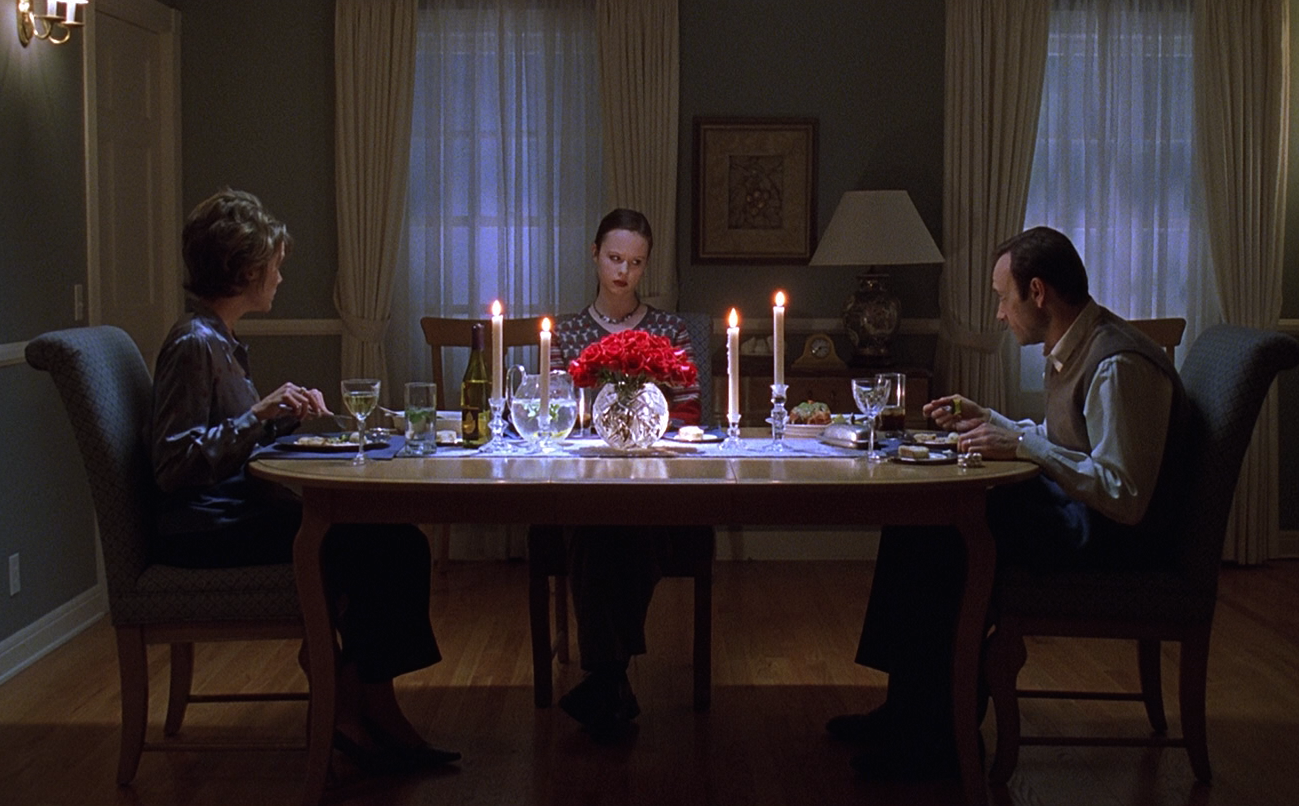
American beauty (1999) (dinner scene) 


I was drawn to this particular scene in the film as it builds up tension throughout the family dinner. Firstly, easy listening, cheerful music is juxtaposed by a heavy door slam and the following tense conversations of the family. Over the course of the meal, the conversation becomes more fast-paced, snappy and voices are raised. As this builds up, Lester Burnam suddenly smashes the plate of asparagus, with such aggression that it shatters. Here, I realised how a very mundane scene, such as eating dinner can be transformed into a dramatic piece, which is more interesting for the viewers. Additionally, the scene sheds us insight into these disturbed characters' mindset, who are dissatisfied and frustrated in their everyday lives.

MY APPLICATION
When writing the dinner scene between Kate and her mother (imaginary) instead of making it a dull sequence, where the pair eat, I wanted to show a lot more, much like the scene in American beauty. My aims were to show the relationship between Kate and her mother, the attributes of these characters, whilst building tension and including an explosive moment. My current ideas are as follows:


  • Kate and her mum start eating in silence, they are very careful with their cutlery, trying to make the least noise as possible. This reflects their OCD nature. 
  • The mother starts to talk critically towards Kate and her voice and the silent sounds of the cutlery begin to amplify, building tension
  • Kate goes to flashback, remembering how her mother never supporting her
  •  She comes out of her flashback, her mother's voice is still in her head. 
  • The explosive moment finally arrives when Kate smashes a plate against the wall (similar to American Beauty). When the voices don't stop, she stabs her mother (imaginary) with a knife. 
I feel like I have been successful with adapting an ordinary scene, into one that reveals the toxic relationship between Kate and her mother. Like, the American Beauty sequence, I believe I have gradually built up dramatic tension, through an initial calm and quiet atmosphere, to a loud and irritable environment. 


German Expressionism: The Cabinet of Dr. Caligari (1920) 

The expressionist style within this film is visually appealing to me, as it projects the psychological aspects of the characters onto the set design. The backgrounds are very distorted and out of proportion, the shadows are dominant, and the sets are heavily imprinted with black paint.
What actually appears to be non-realistic is actually a reflection of the inner-workings of the characters.


MY APPLICATION: 

The German expressionist style was highly influential for me, due to the psychological nature of my film. I also aim to project Kate's mind-set through the sets and colours of the film. For example, in my opening sequence, I want to show a horrific circus, with an emphasis on the colour red, to create the threatening atmosphere, reflecting Kate's nervousness. Like The Cabinet of Dr Caligari, I also intend to use high contrast lighting for more terrifying scenes.